My Post Traumatic Healing Journey

As I headed across campus to Becca’s office, I was deep in thought. My mind spiraling, thinking of a lost connection. The air was cold, but I could not feel it. As I got to Becca’s office, I noticed her light was off. Perhaps she was running behind. She showed up a few minutes later.
Exasperated and out of breath, she asked, “Did you get my message?”
I hadn’t gotten any such message, but I nodded in agreement. She greeted me like she usually did, with a smile upon her face. When I first met Becca at the CMC orientation, she had seemed cold and distant. As she introduced herself and told people that the school offered free therapy sessions, she had almost a restricted energy about her, an energy that I had associated with danger. I had immediately dismissed her as, “Yet another crappy school counselor,” I thought to myself. Something about her had seemed inauthentic, and I immediately did not trust her. You see, I’ve had bad experiences with school counselors. I often had to engage them in mental chess as I attempted to outsmart them. I was no sucker to their manipulations, their false sense of care hiding the wickedness behind their eyes as they attempted to get me to condemn my own flesh and blood.
With the semester almost over, seeking out Becca had been one of the best decisions I’d made. That coldness I had sensed was not malicious, but an attempt at hiding the discomfort she felt in social situations. During one of our sessions, she revealed to me that she was an introvert like myself, who prefers one-on-one conversations as opposed to large groups of people. My brain had registered her social masking as inauthentic, but she was just trying to fit in. Psychologists would call this a cognitive distortion (Grinspoon). Trauma survivors often tend to view things as black and white, good or bad. When I first met Becca, I was projecting my trauma onto her. I often do this unconsciously. My nervous system will immediately assume danger upon meeting anyone new. It’s because of this I have trouble connecting with people and forming relationships.

A few years ago, during one of my first therapy sessions, I was diagnosed with PTSD. I denied the diagnosis immediately. I was just hoping for some kind of help or recognition of my Attention Deficit symptoms. PTSD was never something that had crossed my mind. I mean, I’d never been to war or witnessed a natural disaster. Sure, I had some trauma, but I just couldn’t accept that what I experienced was enough to cause PTSD. Accepting this would cause me to reframe my entire childhood and identity. I was the broken one. I was the problem. I was too sensitive. It was my fault. This is the narrative that keeps me going even now. A need to prove myself and overcome my faults. To obtain perfection.
Diving into PTSD
Have you ever experienced something traumatic and been deeply affected by it months or even years later? Do you find yourself reliving the traumatic event or avoiding situations related to that event? You might be suffering from Post Traumatic Stress Disorder and not even realize it. Many people are under the false assumption that PTSD can only occur in those who’ve experienced severely traumatic events such as war or enemy occupation (Post-Traumatic). But it turns out that is not the case. Trauma is entirely subjective, and some people are more prone to post-traumatic stress than others. Being more sensitive to trauma is nothing to be ashamed of. You’re not less than just because an event traumatized you and not someone else. In fact, experiencing trauma can actually be beneficial and lead to post-traumatic growth.
I am one of those unfortunate souls prone to trauma. I have a lengthy memory, and my nervous system is highly sensitive to the world around me. Ever since I can remember, the world has felt far too much for me. Unable to drown out the chaotic nature of existence, I notice details that most do not. I can sense the pain of others and often feel powerless in its wake. The world itself is traumatizing. I was rejected for my sensitivity and my emotions, mocked for my differences, misunderstood, and made to feel too much. My nature threatened those who did not possess such a deep sensitivity. So I learned to hide it, to abandon myself and those around me. This was a coping mechanism I developed to survive my childhood, but now it’s a detrimental force within my life.
Most of my life, I have felt worthless and out of place, like my voice did not matter. That I am a waste of space, and deep down I am a truly reprehensible person. If my own parents could not value me, then how could anyone else? Due to this negative self-concept, I’ve pushed people away and isolated myself from the world. I developed hyper-independence at the cost of strong social bonds. I fundamentally lack the ability to trust that anyone I get close to will stay. This can cause me to cling to and idealize people who are also hyper-independent. I wrap all of my self-worth in the idea of them, hoping I can get them to show up in the ways my parents never did. These people, of course, like myself, lack the ability to fulfill that role in my life, which is exactly why I cling to them. It’s sort of antithetical. I wither in the despair of my loneliness as I prolong its hold on me. All the while, I push away the people who do care.
While my outer independence masks most of my struggles, my internal world is one of chronic despair. I constantly think negative thoughts, and every barrier life throws at me becomes a series of catastrophic events. No amount of achievement, however, seems to contradict my inner belief that I am fundamentally worthless. That is why exploring these deep-seated beliefs and challenging them is a fundamental aspect of psychotherapy
Exploring Psychotherapy
The world around me slowly faded away. I could hear the muffled voices of the world around me. I was trapped within a memory. A hand gripping my throat, unable to escape the terror. I was haunted, taken back to a time of powerless despair. I could not concentrate, nor feel safe or trust. The calm of the classroom became a warzone. This has happened several times since the start of the semester. Thankfully, Becca was there to help me.
“How’s your week been?” she asks with genuine sincerity.
“Oh, it’s been fine, I guess,” I say hesitantly, thinking of how I embarrassed myself during class. My biology teacher had witnessed my brokenness. I froze up and withdrew from the class. I was failing not only myself but my group. What if my progress thus far has been ruined?
Becca pulls me from my thoughts. “What’s made it fine?”
“I guess school has been going great. I’ve been passing my classes. My teachers are really awesome and supportive. I made a couple new friends, and we went to a concert. It was nice,” I say with a hint of hesitancy.
“That’s amazing! I’m really proud of you,” she responds with a smile on her face.
“Is there anything else that’s happened this week?” she asks.
I often have a hard time diving into my struggles. Past therapists didn’t recognize my hesitancy or that I was holding back. I’d often allow them to guide the session and believe that they were actually helping me, when in reality, I was making no progress. Becca pushes me in subtle ways and offers a supportive space while challenging my need to intellectualize the therapeutic process. Eventually, I revealed to her what had happened.
“I had a flashback during biology class, and my teacher noticed. I tried taking deep breaths and grounding myself, but it didn’t work. My biology professor said she’d been around people with PTSD, and if I ever needed to talk, I could, and that if I needed to step out of class, I was more than welcome to do so. I took her up on the offer and went to the bathroom to let it all out. It was only after that I was able to calm down.”
Becca explained to me that sometimes our nervous system gets stuck after trauma, and mine has had a lifetime of negative signals sent its way. In order to reset my nervous system, I need to teach my nervous system that it’s okay to be in distress, and sometimes I need to interrupt the signals of distress by taking deep breaths, getting up and moving, or by stimulating the vagus nerve. The more that I do this, the more it teaches my nervous system that it has options. I don’t have to be paralysed by the past, stuck within memories. I can work through them and find ways to cope through it.
Learning to Trust
School has mostly been a safe haven for me. I enjoy the pursuit of knowledge and the comfort of others. Recently, I have chosen to confront my past head-on, challenging my perceived notions and maybe even confirming others. Trauma has a way of making you second-guess every glance, every silence, every moment of connection as if it’s a matter of life and death.
“Being traumatized means continuing to organize your life as if the trauma were still going on, unchanged and immutable, as every new encounter or event is contaminated by the past” (Van Der Kolk, p. 53).
I tend to intellectualise my problems, with part of me believing that if I just do enough research or dive deep enough within myself, then all my problems will simply dissipate. This, however, is contradictory in nature. My self-awareness is merely another tool of self-sabotage and judgment. It turns out the source of my healing is not through intellectual pursuit but through the development of healthy attachments and social bonds. For the last several months, Becca has been helping me with my attachment issues and exploring my trauma. I’ve been seeing her every week for the last couple of months. I’ve made significant progress in at least opening up. I’ve been deeply conditioned for years not to trust that people will show up when I need them. Becca has given me a space to be honest and share my thoughts, and to intellectually explore this field that I am so interested in. In my previous attempts at therapy, I was reluctant to open up and trust my therapists. I was in denial that what I had suffered was enough to constitute a diagnosis of PTSD, complex or otherwise. I was resistant to forming real attachment to my therapists. Attachment always meant danger. It meant that I could be abandoned, and in fact, I had been by a few therapists due to circumstances outside either of our control.

Hypnosis/Coaching
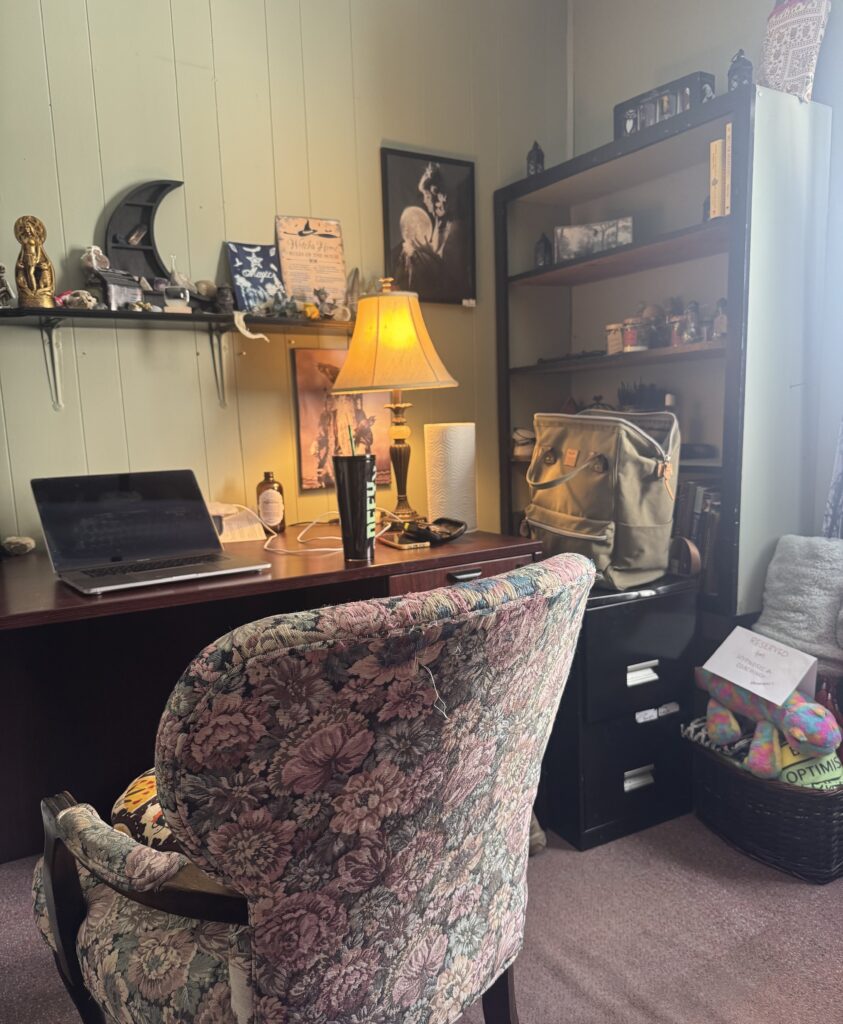
Alongside my therapy sessions with Becca, I have also been seeing Kristen King, a hypnosis life coach. I was skeptical at first. Hypnosis and other spiritual gobbledygook is often used as a way to con the desperate. I suppose that’s what I was: desperate. Despite my hesitance, I grew to like Kristen. She was real and tangible, with a twinge of neurodivergence, streaks of blue in her hair, exhibiting an awkward confidence. This was a stark contrast to most therapists I had worked with. Kristen was unapologetically herself, not limited by the same constraints a therapist might be. She’s a one-in-a-million kind of person, and we were on the same level. It felt good to be able to talk to someone that was just as weird and philosophically complex as I was. I saw myself, or perhaps who I could be, reflected in her. While nothing in our sessions could really be considered hypnosis, the coaching portion of her practice has been helpful thus far. She operates out of a small metaphysical supply store in Leadville called Iris Moon, a far cry from the town’s welcoming center that this building had once been. I’d passed by Iris Moon a few times, wanting to go in but hesitant due to my skepticism around the metaphysical. Yet, I’d followed Kristen on Facebook for quite some time. While a stranger, her posts resonated with me, and I wondered what it would be like to stumble upon her in the open. One such opportunity presented itself. She announced that she was doing hypnosis sessions every Saturday. Despite my skepticism, something about Kristen’s energy drew me in.
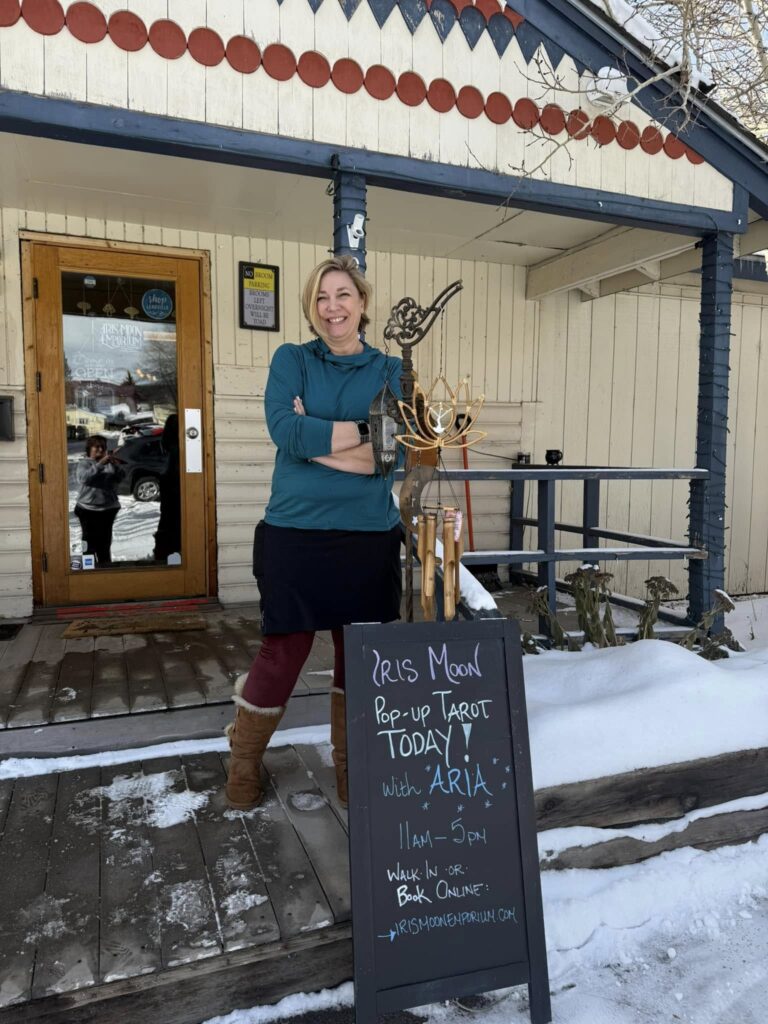
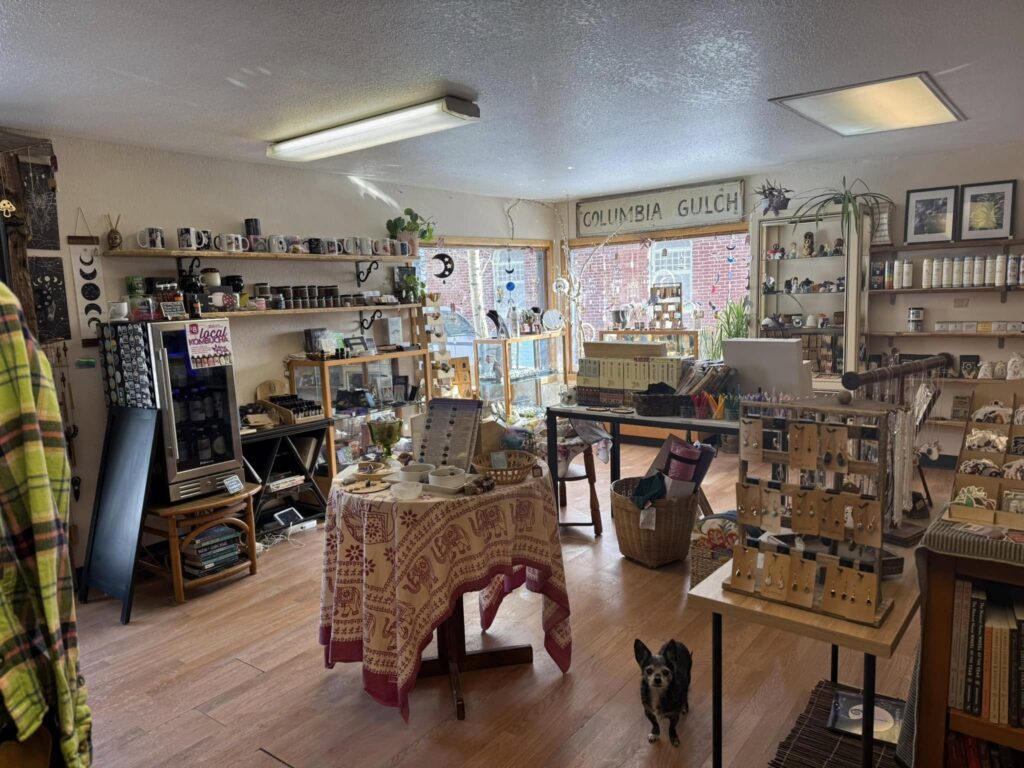
I walked into Iris Moon, surrounded by all kinds of crystals, rocks, and other spiritual objects, the smell of incense wafting through every corner and crevice of the shop. Most of the items seemed tacky to me. Nothing quite spoke to me. If the metaphysical was a tangible, actual thing, then this capitalistic neutering was enough to turn me away. Nothing in here felt like it had been made with love, care, detail, or culture. They lacked the spiritual properties such objects ought to have.
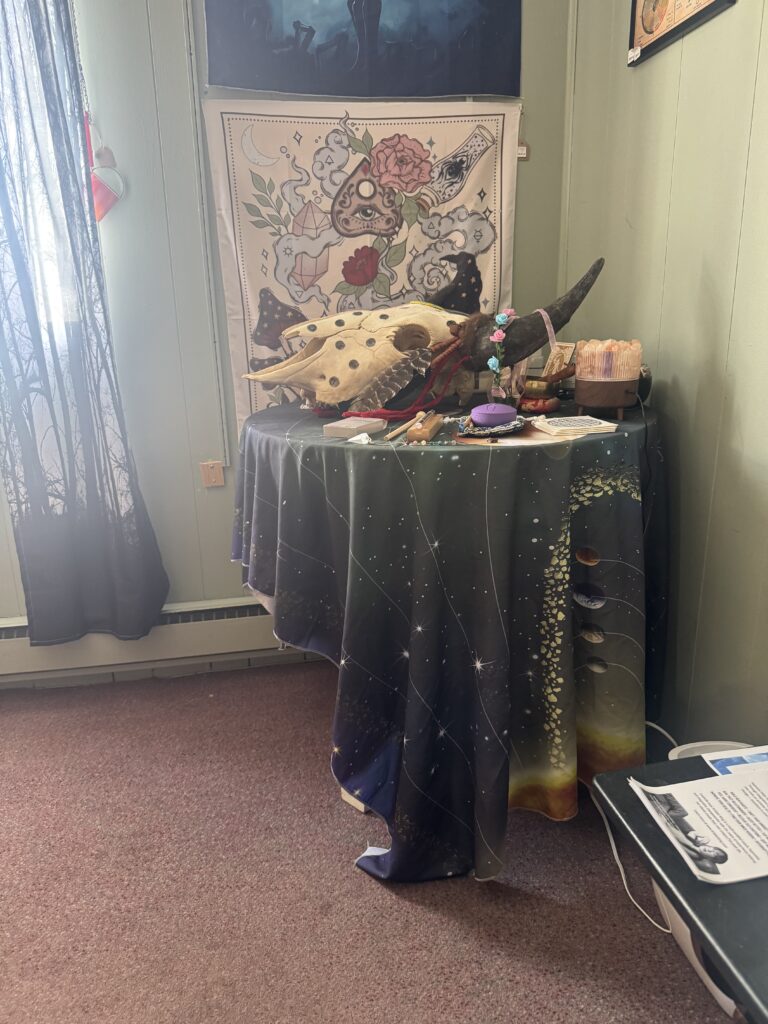
Kristen comes out and calls me into her room. We pass under a curtain as she closes the door. I look around and see a decorated animal skull sitting upon a table, shelves abundant with knick-knacks. She turns on a white noise machine and sits down in front of me. She looks at me with awkward recognition, as if she’s not sure what to make of me.
So what brings you here? What can I help you with today?”
“Well, I’m very skeptical of things like hypnosis or whatever, but I’m also open to experiencing new things.”
She explains to me that she does a combination of hypnosis and coaching and that everything she does is scientifically based. She then asks me what’s a behavior that I’d like to change.
“I have an unhealthy attachment to someone and a strong compulsion to text them impulsively. I never knew what was between us, and she texted me out of the blue saying that she was moving, and I was devastated.”
Kristen, in all her wisdom, said, “Honestly, it sounds like your friend’s lack of a response is more about her own stuff, not about you.”
I paused. “Yeah, maybe… but I can’t stop messaging her. I keep hoping she’ll respond to something, anything. I sent her a long string of messages just letting her know I’d always be there and that I hope she’s not alone. That I don’t give up on people, and that I hoped she doesn’t let people bully her like they did at her old job, and she should express herself in whatever way she wants to. And I said that I thought her eyes were really pretty. I worry that I’m being too much, and she’s just not telling me. What if she thinks I’m weird? What if I’ve ruined everything?”
“Maybe she does. So what?” Kristen says lightheartedly. “The right people won’t judge you for caring too much. You’re stuck on the negative ‘what ifs.’ What if, instead, she’s just dealing with her own problems? What if it has nothing to do with you at all?”
She paused, letting that sink in. “Next time you find yourself spiraling into the worst possibilities, try to also imagine the just-as-likely positive possibilities. Sometimes, when someone is very intellectual and they have nowhere to put all of that energy, they tend to ruminate on negative thoughts. You need to actively work on focusing on the equally possible positive outcomes. Train your mind to consider those too.”
“I know intellectually that that makes sense,” I said, my heart aching. “I know it might not be my fault. That she’s likely dealing with a lot. She never seemed like much of a texter. She tried to connect with me in person, but I was always too afraid to let her in. Sometimes I could see her disappointment, so I’d send her a text explaining myself afterwards, to no response. What if she only likes that closed-off version of me and not who I actually am within my writing? I feel like I’m being too much and she just doesn’t want to say anything. Maybe her silence is her communicating, and I’m violating her boundaries.
“Emotionally, I can’t separate silence from abandonment. I keep thinking if she wanted to respond, she would. I always responded to her within minutes, no matter how busy I was. So why doesn’t she do the same?”
I thought back to the moment we shared in her truck. She’d given me a ride. Lingering outside my apartment, we finally had a proper conversation after orbiting each other for the last year. This wasn’t just a normal friendly gesture. She wanted this to happen. She wanted to know me. She had an interest in my life and who I was. She was the first person I’d been open with about my identity. She said I could always be myself around her. I had found acceptance. She was real, not just a puzzle to be solved or a person to admire from a distance. I felt something, and I think she did too. I couldn’t believe I’d spent the last year too afraid to experience this. As we lingered in the truck, an awkward silence befell us, as if we both didn’t want this moment to end, our eyes locked together. She said she had to go and that she would text me after she took a shower. Later that night, she texted me saying we could take her dog for a walk and watch the sunset sometime. That “sometime,” however, never came. She was always too busy or made plans with others or never responded when I asked what her schedule was. Maybe I had let too much of myself show. Maybe that was why she pulled away. Maybe I was wrong. Maybe I was too much. Maybe there wasn’t anything between us at all, and she was just being nice. At the time, I wasn’t used to that, people being nice.
Kristen leaned forward slightly. “Let’s try something,” she said enthusiastically.
She showed me a grounding exercise, crossing my arms over my chest and giving myself a firm hug while moving my hands across different points of my body, allowing myself to receive the energy and reassurance I was craving from others, but from within myself instead.
As I left Iris Moon, I felt a surge of anxiety, but not the bad kind. Something was different about me. I’d shared my inner feelings with a stranger and developed a mutual likedness with Kristen. I felt lighter somehow. I wish I could claim that this was all it took for me to heal my inner wounds. Maybe I wasn’t as worthless as I thought. If I could enter Kristen’s domain and express my inner self and her not recoil in my brokenness, then maybe my feelings may in fact be valid. Maybe I’m not as horrible as I think I am. Unfortunately, it takes more than a few positive experiences to wash away the lifetime stain of negative experiences. When I’m away from people, I often forget the positive connection we had, not in thought, but in feeling. It’s like a fresh slate. Every interaction is a potential rejection in waiting. I’ll flip-flop in my head about whether or not I need them or anyone else. It’s because of this that something as simple as a missed text message can send me into an existential spiral. I was constantly invalidated and emotionally neglected as a child. My nervous system assumes that this is how everyone will treat me. My biggest fear is letting people into my internal world and being rejected for it. I am making progress, but the healing journey is a long one not to be taken lightly or rushed to its desired conclusion. We often want a quick fix in a world so used to instant stimulation. But the healing of trauma is not one that can be achieved so quickly. I often have to remind myself of this. Sometimes I get caught up in the emotional floodgates of hopelessness, as if I’ve made no progress at all. But I have, and I will continue to do so.
Weeks go by, and I find myself once again sitting across from Kristen. She asks how I’ve been since our last conversation. I had taken steps to improve my diet and exercise during the spring. I was happy to report that this trend had continued, even despite my busy schedule. Ever since I can remember, I have had an unhealthy relationship with food. Where you see me binging, an uncomfortable or stressful situation is likely the culprit. I found refuge in the numbing effects of the binge. It’s a relief unlike any other, one that ultimately ends in negative outcomes. High amounts of processed or sugary foods increase your blood sugar and thus dysregulate your mood. It’s all interconnected.
Kristen had asked me in the session prior: if I was a healthier person, what would that look like? Who would I be, and what would I be doing now? I answered diet and exercise. Kristen had explained to me that to achieve a goal, one must not view it as unattainable but rather already obtained. What if I was the kind of person to take control of my health? So that’s what I did. I started intermittent fasting and walking at least 5 miles a day. This, however, would not be the first time I had done this. I once stuck with these habits for over a year and lost over 60 pounds. I was healthier, but I did not see myself that way. All I could see was the never-ending goal of losing more and more weight. Eventually, I reached a level of stress and traumatic incidents where I could no longer keep up with this impossible actualization. Thus, I gained every single one of those lost pounds again.
Experts will say that this is merely the course for any diet, and perhaps they are right. Maybe at the end of this is another repeat of the past. This is the conflict of self-help and trauma, a need for control, a battle of health and restriction. In the untraumatized, the goal of health is an admirable one. But in the traumatized, it can also be another tool of self-destruction and harm, reinforcing even more impossible standards to meet.
I opened up the session with this positive news. I’d been able to stick to such a restrictive diet for so long. I’d changed my behavior just as she had suggested. This was good news, right? Well, I still felt like I wasn’t doing enough. I was still eating too many carbs. Still not losing enough weight. Still not able to do anything other than walking. If I truly wanted to be the person on the other side who took fitness seriously, then I should be in the gym, strength training, taking supplements, and avoiding processed food entirely. But that was far too much change to be realistic. I did what I could with the tools I had at my disposal.
Kristen warned me that if I pushed myself too hard, I could actually send my body into a state of self-destruction to the point I’d actually gain rather than lose weight, and that I should find a healthy balance. As the conversation continues, she asks what it is I want to tackle this week. So I tell her of my emotional flashbacks and inability to escape my past. That’s when she tells me of a technique known as bilateral stimulation.
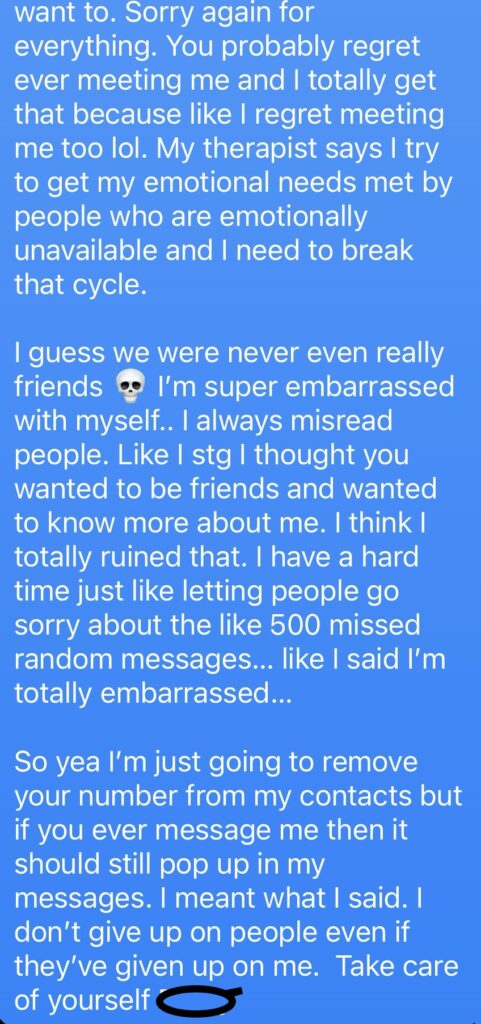
Kristen explains to me: if you’re able to stimulate two sides of the body through movement, this will activate both sides of the brain, allowing for the processing of negative emotions and traumatic memory. She had me bring up the worst feeling I could think of. But nothing seemed to elicit the emotional reaction she wanted. So I pulled out my phone and read my goodbye message.
As it turns out, moving wasn’t necessarily an “Okay, I’m gone, I don’t want to talk to you” kind of situation.
After I had sent her numerous paragraphs, some supportive, others just venting about my struggles with loneliness, how I hated my job, or living with my parents, and how much her kindness meant to me, I finally got an update.
She had gotten a new job. Said it was nice. That she gets to bring her dog with her.
I had mentioned how my coworker Juan, who she worked with, had given me a ride and “forced” me to listen to his Spanish music, and how I wished I could speak Spanish.
She replied back: “We should both learn Spanish. Give up on English for a while.”
So… there was a we?
Of course I’d cling to that. But she’d go silent again soon after.
As the cycle continued, I began sending her a daily spew of my inner world. Eventually, I realized I couldn’t keep stretching myself thin hoping for something that was never going to happen.
I sent her one last message letting her know I’d be removing her from my phone. That I was sorry. That the whole “500 missed messages” thing was so embarrassing. That she probably regretted meeting me. Maybe I read too much into our interactions. I mean, we were never really friends, right?
I ended it by saying that if she ever needed me, she could always text me. That she’d still pop up in my messages.
Sending that final message was difficult. It was emotionally raw. I didn’t want to hurt her, but I couldn’t just remove her and say nothing. I had to be honest. I left the door open. A door she has yet to take.
I felt grief. I was stuck in this pattern, desperate to get something back from her that she didn’t seem capable of giving. All I wanted was communication, an acknowledgment, or even a denial of my feelings. But all I ever got were crumbs.
As Kristen had me do bilateral stimulation, this feeling almost immediately dissipated. It worked. I wasn’t stuck with this negative feeling forever.

After my success with bilateral stimulation, I decided to ask Becca if we could start EMDR, a process that utilizes bilateral stimulation to process and heal traumatic memories. I had explained to her that Kristen had shown me how to use bilateral stimulation to calm my nervous system and how she had me bring up negative emotions and then use bilateral stimulation to calm the following negative feelings.
This caused Becca to pause and explain to me the ethical problems with Kristen, pretty much practicing therapy as an unlicensed person, and how it could interrupt my healing process if not handled delicately, especially if I was going to start EMDR. Which, I guess, makes total sense. Two different people with completely different backgrounds could send me in all kinds of different directions.
She clarified that she wouldn’t make me choose between either of them, but that she wanted to be sure that Kristen wasn’t interfering with her therapeutic process. So she asked if it would be okay if she contacted Kristen in order to document my process properly. So I gave her my consent to share things with Kristen.
While I personally find value in having these vastly different kinds of treatment in my life, I like Becca would advise against this.

Conclusion
Healing from trauma is a lifelong journey that comes in many different forms, and it’s one that I have willingly chosen to embark upon. I’ve watched this disease consume the lives of my family, unknowingly passing it down. I couldn’t be a part of yet another generation to pass on this curse. I’d rather use my time to heal and help others do the same.
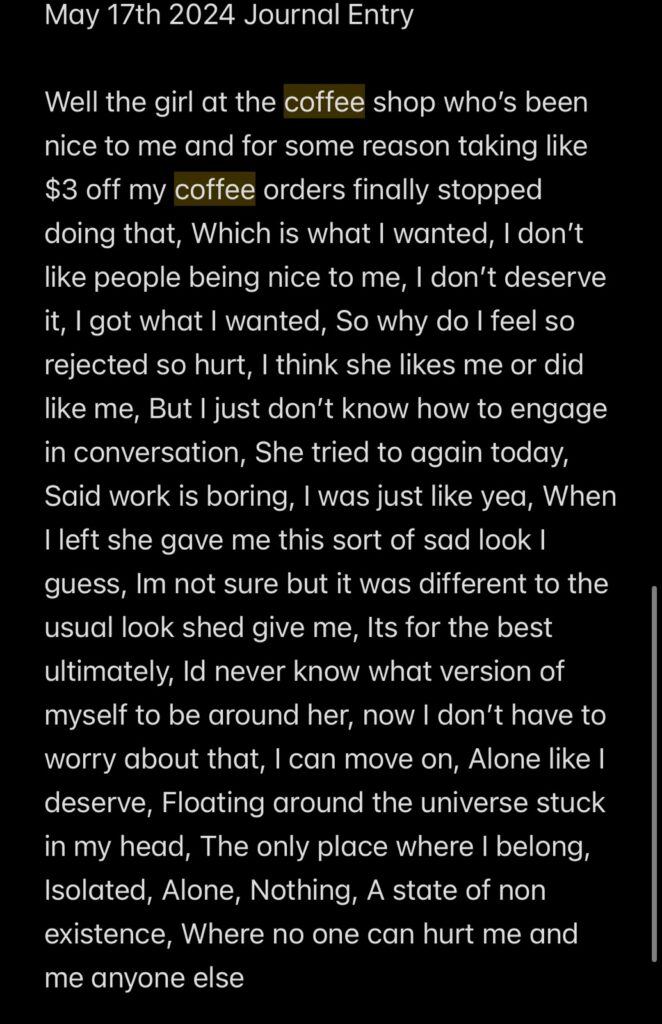
There’s so much stigma around mental health and trauma. I think it’s important that we challenge that. Some might call what I’ve written here vulnerable and brave, but I just see it as honest and real. This is what it’s like to be afflicted with trauma. This is how it feels to live in my head… while also being neurodivergent, so my experiences may differ from the general population. But the point is, I still have a long way to go and a ton to learn.
While I still have some ups and downs, I’m now able to challenge my immediate thoughts and behaviors in response to those ups and downs. I’ve found people that I can talk with and share with. That in and of itself is so meaningful.
As Gabor Maté would say, “People don’t get traumatized because of the hurt but because they’re alone with the hurt.”
Maybe you don’t need EMDR, or hypnosis, or even to change your unhealthy habits. Maybe all you need is someone to listen. If you’ve been hesitant to start therapy and have the ability to do so, the only thing you have to lose is not going to therapy.
I’m still not over her, the unnamed object of my attachment. I hate that phrasing, she’s not an object, she’s a person. But to my nervous system, she represented everything I wanted: to be seen, to be valued, a chance at genuine connection. Her silence reinforced every negative thought I had of myself.
It wasn’t her that I was attached to, but rather the idea of her. In a way, I’m thankful that things went the way they did. When I walked into that coffee shop a year ago, I had just left an abusive relationship. I was left to pick up the pieces of my life. She showed interest and kindness when I really needed it. Who knows? Maybe she needed it toPeople often think the resolution is to get over things. But I think it’s more about getting through them. There will be other people who come into my life. Because of her, I’ve learned that it is possible for me to find connections. I just have to be willing to put the work into healing my trauma and confronting my past head-on.
First Draft https://thepsychdigest.com/first-draft-film-review/